

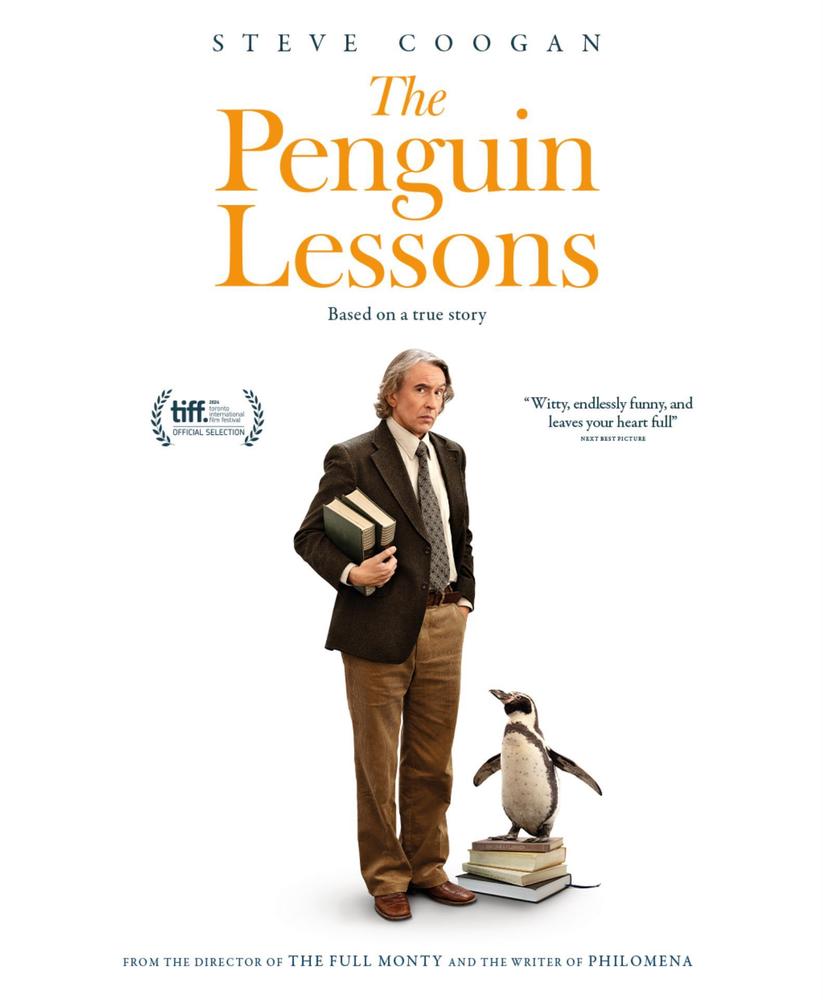
Films about penguins are always interesting, intriguing, often delightful. 2024 saw the release of My Penguin Friend as well as the Penguin Lessons. Both are set in South America, the former in Brazil, the latter in Argentina. The former is set in the present, the concern for penguins and the environment. The latter is set in 1976.
1976 was a significant year in Argentinian history, civil unrest, the coup by the generals and their continued military dictatorship for the next eight years (including the Falklands War). This is very much the atmosphere of this story. However, the focus is on an Englishman, Tom Michell, the screenplay a fictional adaptation of his memoir (and, as often the case these days, some footage of himself and the penguin during the final credits).
Tom is a teacher, has been drifting for years through the US and Latin America, saddened, isolated, sardonic, not coping with the death of his daughter. He is welcomed by the principal of a privileged high school for the sons of wealthy Argentinians (including generals). The principal is played in a very proper English manner by Jonathan Pryce.
And Tom is played by Steve Coogan, an actor comfortable in both drama and comedy, seen to advantage in the National Theatre Live version of Dr Strangelove where he plays four satiric characters). Here he is rather world-weary, trying to teach his class English language and literature, forced to coach Rugby which he dislikes, intending to coast along in his life and work.
As with any visitor to Buenos Aires, he decides to catch the ferry across the Plata, a visit to Uruguay for some kind of relaxation. Instead, he and a companion from the nightclub, find a penguin covered in oil from a slick. He is happy to abandon it. She wants to clean it, care for it. And long story short, the penguin becomes his responsibility, getting it through police checks and Customs, concealing it, trying to get rid of it, bringing it back to the school and ensconce it in his apartment.
And, there are many penguin lessons, the penguin becoming in the words of one of the alert students in the class, a metaphor. The penguin, now named, is a hit with the boys, uniting them from their mischief and bullying, paying attention, eager to feed the penguin, it’s becoming a football mascot.
Interestingly, everybody talks to the penguin, now named Juan Salvador, especially Tom. His rather demanding landlady and her daughter are charmed. His co-teacher from Finland is able to pour out all his personal troubles to the penguin. And, after being initially taken aback, of course, even the principal talks to the penguin. So, happy penguin lessons at the school.
But, this is the year of the coup, the cleaner’s daughter involved in protests, snatched by the police in the street in front of Tom, his not venturing to help, then the disappearance of the shopkeeper who supplied fish to the school, and an episode where Tom with the penguin sees the police chief who headed the abduction, sitting in a cafe, his little daughter patting the penguin, but a severe reprimand for Tom and then his being arrested, interrogated, tortured and released. This atmosphere pervades the latter part of the film.
While there is a happy ending at the school, the boys the better for Tom’s classes and his advocating of social equality and care, and the presence of Juan Salvador, all graduating. And the headmaster decides to use his influence with the parents to obtain the release of the imprisoned cleaner’s daughter.
This is a British film, an adaptation of the memoir, directed by Peter Cataneo (famous for his direction of The Full Monty), some British reserve and reticence as well as sarcasm and sardonic remarks, which avoids an over-sentimental appeal, but nevertheless has its moments of laughter – and, perhaps to the surprise of some audiences, some tears.
19 Brenbeal Street, Balwyn VIC 3103
Telephone: 03 9816 9291
Email: [email protected]
Office Hours:
Tue - Fri 9:00am – 5:00pm