

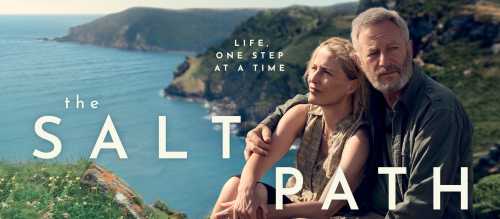
The depth of enjoyment of The Salt Path may well depend on how audiences identify with walking, hiking, or being observers and admirers of walkers and hikers. The Path runs along the south-western part of the coast of England, several hundred miles of walking, hills, beaches, crags and cliffs, passing through small towns. And this is where the audience accompanies the central characters, husband and wife of many years, Moth and Ray.
The strength of the film is very much due to the central performances. Gillian Anderson is the wife, Ray, Raynor Winn the author of the bestselling book on which the film is based (and she serves as one of the producers). Jason Isaacs is Moth, the husband, a strong character, but diagnosed with a rare and severe illness, impairing action in his left side, his limp, difficulty in swallowing, but a determination to live with and go beyond his illness.
They have been married for many years, and the two actors are able to convey most powerfully the bond between the husband and wife, love, the devotion, the care, the mutual understanding and appreciation. This perspective is one of the great values of the film.
However, hard times, business difficulties, unfamiliarity with the law and then losing their case, leading to the loss of their farm. They are homeless and make the decision to walk, following the path to Lands End.
As suggested, enjoyment of the film will depend on the audience response to walking, identifying and sharing the literal ups and downs, difficulties and joys, encounters with cranky people objecting to them camping, friendly people who are supportive with food. The couple had very little money, their tent and all their belongings in their packs, and they walk. Walkers will appreciate their journey; hikers will be able to make comparisons from their own experiences. And the rest of us will be watching with some kind of admiration with moments of apprehension.
The look of the film is very British, the characters, the landscapes, behaviour in the towns but with some moments of exhilaration as, stuck for money, Moth being identified wrongly with a poet who is doing the walk, his actually making a powerful recitation of poetry in a town square, and the admiring audience willing to add to the collection.
They do have a friend, Polly, who does offer some help, accommodation, Moth doing repairs and, surprisingly, Ray working hard in a shearing shed, war collecting, giving them some money to establish themselves.
The film has been directed by Marianne Elliott, a director better known for screen adaptations of theatre performances of significant plays, Alls Well that Ends Well, Angels in America, War Horse.
The finale offers interesting information, the decisions that Moth and Ray make about further studies, helping local farmers, and the status of Moth’s health. Ray’s account of the walk and their situation was a bestseller, an inspiration to the many who have read it. And the film will add to this admiration.
19 Brenbeal Street, Balwyn VIC 3103
Telephone: 03 9816 9291
Email: [email protected]
Office Hours:
Tue - Fri 9:00am – 5:00pm