

Caesarea Philippi was a little town near Mount Hermon and the northern outpost of the Holy Land, a place quite different from most of Galilee. It was the administrative centre for Herod’s son Phillip, and was sited near an important spring that bubbled up out of a rock face and fed south to the headwaters of the Sea of Galilee. The town was built facing this sheer cliff into which were carved niches for statues mostly worshipping the god Pan. Here, in a Hellenistic/Roman town facing the worship of a number of pagan gods, Jesus asked the apostles, “Who do YOU say that I am?”

Peter’s great statement of faith “Thou art the Messiah, the son of the living God“ leads to that extraordinary commendation, “you are Peter the rock and upon this rock I will build my church”. From here the fisherman and follower gradually assumed the role of leader. He became, as we are given to understand, the central figure of both the complex organization and the buildings which we call the church today.
But the process to papacy was not as simple as that.
Firstly, what did Matthew’s gospel mean by ekklesia, the Greek word we translate as church? (The four gospels were written in Koine Greek which was the common language throughout the First Century eastern Mediterranean.) The term refers to an assembly or gathering of people; it had no overtone of either a place or a religious institution. The word is used only three times in the gospels (all in Matthew), but time and again in the Acts of the Apostles which is Luke’s account of the first three decades of some early Christian communities; it moves from the time of the Ascension to around Paul’s imprisonment in Rome 62 CE. Here in Acts the word has become a bit more specific; it may mean the local Jesus community or if used in the plural refers to the various groups of believers spread through Judea or Galilee.
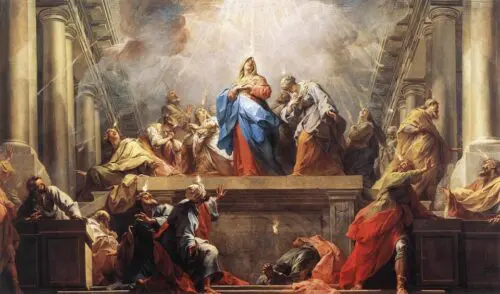
The account we get from Acts gives a sense of the group of disciples spreading from their first ecstatic footing at Pentecost: groups of both Jewish and then, crucially, Gentile believers. The apostles’ first understanding was that Jesus was the Messiah promised by the prophets to the Jewish people, but both Peter and Paul saw Him as for all nations. The turning point was settled at the Council of Jerusalem (49-50 CE) where Jewish legalists argued that converts should first be circumcised and follow the Mosaic Law in order to achieve salvation in Christ. At this meeting, Peter is recorded as speaking first – indicative of his leading authority – saying that God gave the Holy Spirit to Gentiles and Jews, purifying their hearts through faith rather than ritual. Paul had come to the Council from gentile territory in Antioch; he strongly agreed with Peter, while James the leader in Jerusalem (perhaps rather more conservative) and a ‘brother of Jesus’ proposed a final dietary restriction that was mutually agreed.
These early leaders expected that Parousia – end time and the second coming of Jesus – would occur in their lifetimes, and so there was little thought of setting up any permanent organisation. It is for this reason that the earliest documents we have in what we now call the New Testament are letters, epistles written to encourage, explain, reprove or hearten new believers in various cities across the Empire – 14 from Paul and seven from other leaders like Peter, James, John or Jude. These were read out to various communities and (hopefully) kept for future reference. The Gospels, which of course are first in time, were actually written some decades later, after the deaths of Peter and Paul and after the Roman destruction of Jerusalem (70 CE) when any first-hand memory of Jesus’ teaching was fading.
So what do we know of the spread of early Christianity? Initially it was a minor eastern religion, but it spread along those first routes of communication – the Roman roads – via little groups of Jewish believers and traders or travellers. They gathered in homes with like-minded friends to pray together in cities throughout the Roman Empire. Apostolic preachers, of whom Paul was certainly the most significant, were often not the first Christians in cities like Ephesus, Corinth or Rome. Often there were quite different groups in these places, sometimes at theological odds; Paul would on occasion send a trusted assistant in the hopes of bringing order; at times he chose elders/presbyters and deacons to serve and guide communities. We know less of Peter. He was clearly the leader and the first part of Acts shows his miracles, miraculous escape and authority at Jerusalem, but the account of his travels stops there; we know nothing else for certain of his life. The two letters attributed to him (which might tell us more) are each in quite different styles, in addition they are written in polished scholarly Greek unlikely to belong to Peter himself. So, while we know from his own letters that Paul lived – partly as prisoner – and taught in Rome, we have only tradition to say that Peter too went there and that they were both martyred during the persecutions under the emperor Nero about 64 CE.
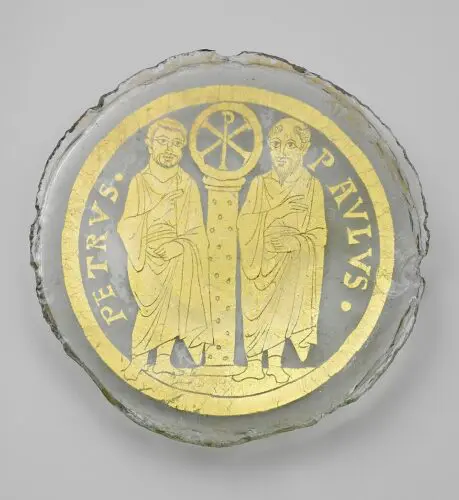
However, the tradition of them both being there was very strong and was never questioned in any later church writings. Within a hundred years there are accounts of shrines at the sites of their martyrdom, Peter on the side of the Vatican hill, Paul outside the walls where he is buried on the Ostian way. A few generations later Irenaeus, (a Greek) bishop of Lyon in France said that ‘the church had been founded and organised at Rome by those two glorious Apostles Peter and Paul’. We know that this was not the case; there were thriving groups of Jewish Christians in Rome as early as 49 CE when the emperor Claudius was alarmed by disturbances in the city caused by followers of ‘Chrestus’, and expelled them. Two of those were Aquila and Priscilla – whose house we know from St Paul was the meeting place of a church. Not the church. And Rome was slow to choose a chief presbyter or bishop partly because the groups of Christians there were so various in their origins. However, the pattern of first-generation believers gradually gave way to a clearer organization of a single bishop, with a group of elders to support him; these moves were increasingly important as various heresies sprang up easily in divided churches.
At this point the church in Rome, the hub of the Empire, and reflecting on the authority it derived from both Paul and Peter, began to compile a succession list of Roman bishops, remembering various influential names in early church groups. Irenaeus (mid second century) names twelve (neatly paralleling the Apostles) but the 6th man is named Sixtus – the list seems more orderly than real. And whatever authority Rome may think its bishop had, papal authority was not always accepted by other Christian groups. The date of Easter was a contentious issue for centuries, but the 4th century heresy of Arianism divided Christianity and further threatened what stability the Roman Empire had achieved under its new Emperor. (The 3rd century had seen civil war and plagues ravage the Empire. Of the 25 emperors in 47 years only one died in his bed.)
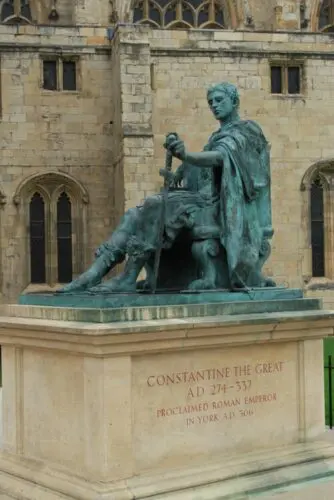
At this point the status of Christian communities radically changed. The emperor Constantine legalised Christianity in the Edict of Milan 313 CE and would convert himself in later life. The Church was on its way to becoming the official religion of the Empire a few decades later. To settle the heresy, he organized and funded the Council of Nicaea. Pope Sylvester was too old and frail to attend; he was represented by two priests who sat in seats of honour but really the driving force was Constantine. The assembly produced together the great Nicene Creed of belief after three months. In the meantime, the group of Christian believers who were once persecuted as martyrs, was now not only accepted, but developed into a vital part of the organization of Empire. Church and state were intertwined.
Constantine’s approach to the papacy was authoritarian: he saw the pope at times as an imperial civil servant responsible for maintaining social stability and order. On the other hand, he gave the papacy property, financial status and legal privileges to increase its standing. He gifted the Lateran Palace which became the primary papal residence for a thousand years, he gave the Roman clergy extensive tax concessions and allowed the church to inherit property. Bishops were given authority to act in some civil matters but perhaps the most public and long-lasting gesture was that he funded and built a vast basilica over the site where St Peter was traditionally martyred and buried.
Now a basilica layout was not new, it was a well-established design of a multi-aisled public hall used for law courts, commerce, massive indoor gatherings: it deliberately did not look like pagan temples or sacred sanctuaries. This first design for St Peter’s as a Christian building adapted easily to cope with numbers of pilgrims or burials or other funeral celebrations; it was not initially conceived of as a church such as we think of today. Reputed to hold from 3,000-4,000 individuals, people jostled for burial space under the floor to be close to St Peter and in later years Mass was attended by 1,000 people. The open-aired atrium in the forecourt was called Garden of Paradise; it contained a fountain which worked as a cleansing spot for visitors moving from the secular world to the sacred one. The site was laden with associations of prayer, as well as power and tradition and it lasted in Rome as a visible representation of papal authority for 1200 years. Its significance only grew after Constantine moved his capital east to Constantinople and in the resultant void left the Church as the most significant authority in the western world.
Which is just the beginning of the Saint Peter narrative.
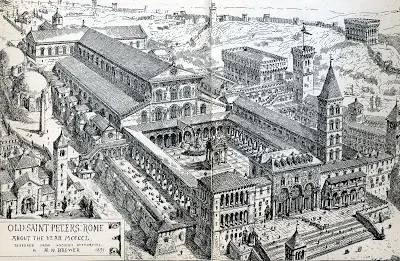
Image 1: The cliff face at Caesarea Philippi (Source: Wikimedia Commons)
Image 2: Pentecost by Jean Restout the Younger, French 1732 (Source: Wikimedia Commons)
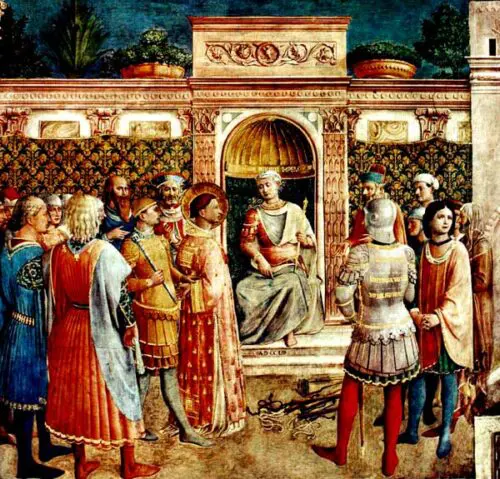
Image 3: The painting is by Fra Angelico, painted 1447-51 for the Niccoline Chapel in the Vatican City. It is of the martyrdom of St Lawrence before the emperor Decius (cir 250 CE) (Source: Wikimedia Commons)
Image 4: 4th century bowl base with Saints Peter and Paul (Source: Wikimedia Commons)
Image 5: Statue of Constantine outside York Cathedral UK where he was first proclaimed emperor. (Source: Wikimedia Commons)
Image 6: A reconstruction of Old St Peter’s from the 1890s. (Source: Wikimedia Commons)
19 Brenbeal Street, Balwyn VIC 3103
Telephone: 03 9816 9291
Email: [email protected]
Office Hours:
Tue - Fri 9:00am – 5:00pm
Loreto Brady says:
Enjoyed reading this early history of the Church. Fascinating. Thank you Sandy.
Laura Facci says:
You never cease to amaze me with your knowledge. Thank you for sharing this history of the early Church. So very interesting.
david rush says:
Such an interesting article on the early history of the church
Delisa, could you persuade Sandy to agree that her outstanding writings be collated into a book It would have to be a best seller